Just when we were getting ready to leave, we found what my dad calls "The Magic Log." It was a dead log that was infested with termites. Saw lots of bird varieties swooping in for a tasty treat!
--written by Ima and her family
 |
| This Mourning Warbler was so fast and in-and-out that I only got one pic of it! |
 |
| Blackburnian Warbler |
 |
| Blackburnian Warbler |
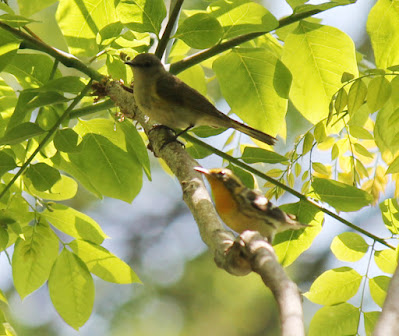 |
| This Blackburnian Warbler likely only came down from the treetops for the termite breeding flights. (Plus American Redstart) |
 |
| This White-eyed Vireo was a big surprise, as we didn't even notice it was different! |
 |
| The White-eyed Vireo has one fossil discovered; a wing bone about 400,000 years old, from the late Pleistocene (or ice age). That bone is also the only fossil record for the entire family Vireonidae, or Vireos. |
 |
| This Yellow Warbler was posing in the sun |
 |
| ...It then ate some termites. |
 |
| ...and some more. |
 |
| The nuptial flights are found in ants, termites, and bees. The nuptial flights are when a mature colony produces males and young queens, both with wings, then they go out, mate, the males die, and the queens lose their wings and start their own colonies. |
 |
| The termite log was attracting all kinds of birds, even House Wrens. |
 |
| House Wren |
 |
| House Wrens |
 |
| This Gray Catbird was just coming back over and over again to this log. |
 |
| It loved the termites. |
 |
| Yellow Warbler |
 |
| Yellow Warbler |
 |
| Yellow Warbler |
 |
| Of course the American Redstarts couldn't resist the allure of the log, as they often work so hard for their bugs. |


